Posts

Who destroyed Manyapura- capital of a once glorious Hindu kingdom of Western Gangas?

Image
Manne or Manyapura was once a flourishing city. It is located about 60 km north-west of Bengaluru, India's 'Silicon Valley'. In the 8th century it was the royal residence of Sripurusha, king of the Hindu Western Ganga dynasty which ruled for many centuries over Gangapadi- which today is roughly the region of south interior Karnataka state. Their capital was at Talakadu, hence they are also known as Talakadu Gangas. In early 11th century CE it was destroyed in an invasion by Rajendra Chola, another powerful Hindu King, who ruled not only south India but many parts of south-east Asia. Due to his destruction of the Talakadu Ganga dynasty (or perhaps due to his expedition to River Ganga in north India), Rajendra Chola was titled ' Gangaikonda Cholan ' (the Chola who captured Gangas). Ruined idol of Lord Ganesh, along with ruins of idols of Nandi, the sacred bull at Manne village, about 70 km north-west of Bangalore, India's 'Silicon Valley'. Location of Many...

Destruction of some Hindu temples and heritage sites in south India between 2011-2020 - A study

Image
Research and author: Ameen Ahmed Background India is a land of temples. There are hundreds of thousands of them across the nation's landscape. While some are new, there are many that are centuries old. If you are a hiker/ trekker who likes to climb the many hills in the old Mysore region of Karnataka state, you cannot miss seeing old temples, forts and other historical structures, that have been dug up by treasure hunters. This vandalisation and destruction, has in recent years been given political colour in many states of south India. A political party and its affiliates attributed the vandalising of Hindu temples across Andhra Pradesh in 2020 to anti-Hindu religious bigots. Subsequent investigation by the state police revealed that the same was not due to bigotry but a variety of other reasons. Of the twenty eight cases of idol desecrations six were for treasure hunts (1). This essay studies instances and causes of damage to Hindu heritage sites in south India between 2011 and 20...

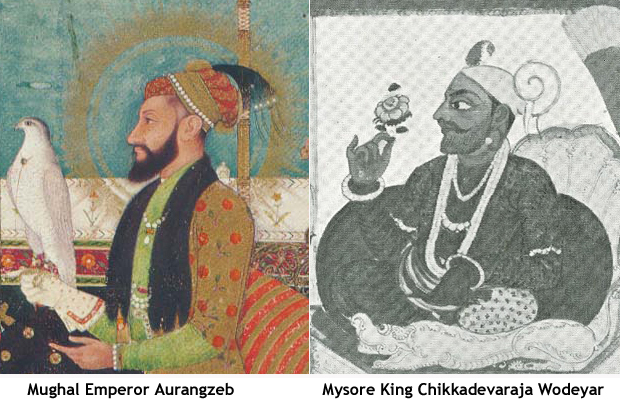
Aurangzeb’s friendly relations with Chikkadevaraja Wodeyar, Mysore Kingdom’s most successful independent Hindu King

Image
Research and author: Ameen Ahmed ~~~ Source: Wiki Commons   Introduction The Hindu Wodeyar dynasty formed the Mysore kingdom in 1399. 1   It ruled the region until India’s independence, with a couple of breaks in between, from 1760 to 1799 and 1831 to 1881. Established as a subsidiary of the Karnata Empire (popular as Vijayanagar Empire), the Wodeyars began to spread their wings after Vijayanagar was sacked at the battle of Talikoti in 1565. 2  During its long existence it saw the rise and fall of many empires, including the Mughals and Marathas. Chikkadevaraja Wodeyar who ruled from 1673 until his death in 1704, is seen as its most successful king. This essay highlights how this far sighted ruler developed and sustained friendship with Aurangzeb to not only check their common enemy the Marathas, but also to reform his kingdom. Mysore King Chikkadevaraja Wodeyar built or repaired many Hindu temples in his reign, like this Shvetha Varaha Swamy temple at Mysore. Pictur...