Posts

How Haidar Ali and Tipu Sultan's Mysore Kingdom overcame Britain’s industrial revolution war inventions

Image
Research and Author: Ameen Ahmed A British era cannon at Darya Daulat Bagh, Srirangapatna, southern Indian, the capital of Mysore Kingdom for many centuries until 1799. Pic: Author   An 18th century Atlantic slavery relic in Karnataka In September 2016, I was guiding a Canadian visitor through the palace and ruins of Srirangapatna. Among the many relics of British rule over India are the cannons one can see at many places like Srirangapatna, the erstwhile capital of Mysore Kingdom. At Darya Daulat Bagh, the summer palace of Mysore ruler Tipu Sultan, a couple of cannons have a curious GR mark engraved on their first reinforce (the part of the cannon that follows the vent). 18th century British cannons had certain words and numbers engraved on them. Among other things these coded engravings reveal the foundry where the cannon was cast or the person who owned that foundry as well as weight of the cannon barrel, size of the cannon ball it fired and name of the king who reigned ov...
Fight for freedom in south India - Srirangapatna uprising of 1857 CE

Image
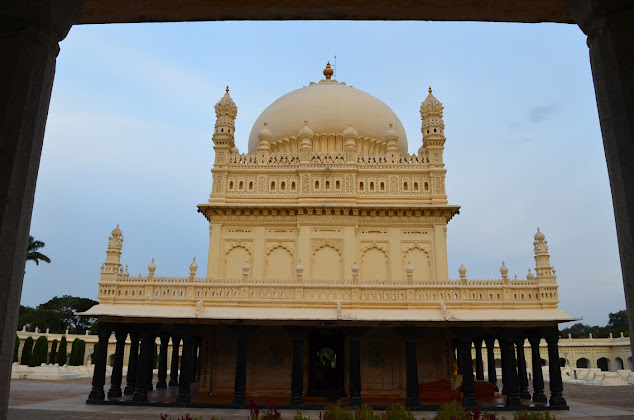
Research and author: Ameen Ahmed The Vellore Mutiny by late Tipu's family and his supporters in 1806  CE is quite familiar to history lovers in this part of the world. What is not known is that 58 years after his death people of Srirangapatna gathered at Tipu Sultan's mausoleum and hope to free India from the clutches of British imperialism. In this story let's learn about a rare spark of India's first war of independence in the country's south and how it is connected to the practise of a martial race of India being allowed to carry weapons to this day.  The mausoleum housing the graves of Mysore rulers Haidar Ali and his son Tipu Sultan. Lewin B. Bowring wrote in 1893 that Muslims of Srirangapatna gathered here in 1857 to pray and dream of freeing Mysore Kingdom from British rule Pic: Author The year 1857 CE is widely considered as India's beginning of fight for its freedom from British occupation. In that sense people who participated in this struggle ...

Tipu Sultan's victims, or perpetrators of worst human slavery? Nayars of Kerala in 18 and 19 centuries CE

Image
Research and author: Ameen Ahmed Critics of Tipu Sultan (and Haidar Ali) give examples of four major communities as proof of brutalities and religious bigotry of these father-son rulers- Christians of Coastal Karnataka, Nayars of Malabar (Kerala), Coorgis and Brahmins, particularly the Mandyam Iyengars of Melukote. The later three are often clubbed together as Hindus. And then there is a counter against these arguments by authors who believe Haidar-Tipu were just like other rulers of that day and age- neither heroes nor villains but a product of their times. A closer look at the social structure and caste hierarchy of Kerala in the 18th and 19th centuries and the place of one of the castes- the Nairs during the period, suggests the conflicts may not have been religious. It is well known fact that Haidar Ali rose to power from the position as an ordinary soldier in the army of the Mysore Hindu Wodeyars in early 1750s. But what is not known much is that when he joined service of W...

Sexual violence and misdeeds of the Peshwa Maratha soldiers in Karnataka

Image
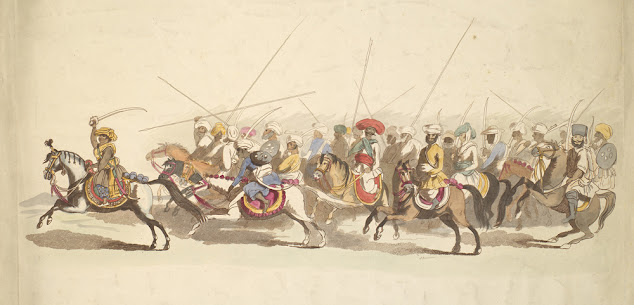
Introduction There is a belief in today's mainstream political discourse in India that the Maratha Empire favoured ' Hindu nationalism '. This essay highlights how  during their repeated invasions of Karnataka (Mysore Kingdom) in 17th and 18th centuries CE, Maratha soldiers committed sexual violence against Hindu Kannadiga women, after  having deliberately destroyed dozens of towns and temples . There was also an instance when the Peshwa Maratha camp purified its entire camp after a member of Maratha Army's Brahmin advisor near had a sexual intercourse with a married Dalit woman near Shivamogga (Shimoga), around  Jan. 3, 1792 when  the town was captured from Tipu Sultan's army.  'Sketch of the advanced guard of the Mahratta army, coming to join Earl Cornwallis, near Seringapatam 26th May 1791' (1).  Source : James Rennell, 1792, Downloaded from the website of Royal Collection Trust on Aug. 25, 2020    Witnessing the Maratha Emp...